___________________________________________
Letters of credit are needed in international trade, that is, trade between companies in different countries. These letters of credit have been utilized in international trade for centuries. Letters of credit issued from the issuing bank act as a substitute for the credit of the purchasing company. Once the buying company provides a commercial letter of credit to the seller, via a bank, the seller, known as the beneficiary, can be assured of payment from the issuing bank. If the bank is trustworthy, the seller can expect, if the conditions of the contract between the two parties are met, to receive payment. The use of commercial letters of credit reduce risk between to contracting entities, and facilitate international trade.
Before a seller of goods in one country ships goods to a company in another country, the seller wants to be sure of receiving payment for the goods shipped. That is where banks come into play. These banks act as intermediaries between the two companies in the different countries. The banks involved in the transaction provide guarantees to the two parties that the goods shipped are the goods ordered and that payment is made once the goods arrive the destination country.
The problem now is that banks - due to the current financial crisis - are either refusing to issue letters of credit or raising the fees they charge for their issuance - creating havoc in international trade. Shipments are "sitting on docks, in warehouses, or in the cargo holds of ships, orders are being canceled, or not even placed. The global supply chain which connects producers with consumers is breaking, and the consequences will be dire indeed." Financial Crisis-Shutting Down World Trade
Having lived in Thailand for several years, I've grown to like Thai jasmine rice, considered by many to be the world's finest rice. Recently, I tried to purchase Thai jasmine rice and was told that Thailand has suspended shipment of Thai rice to my country of residency. My guess is the unavailability of Thai rice is due to the failure of the commercial letter of credit system between the suppliers of Thai rice in Thailand and the buyers of rice here.
I asked myself, "What will the restaurants that serve Thai rice do now? The other rice available is not the same quality nor does it taste like Thai jasmine rice. How is a Thai restauranteur going to call itself a Thai restaurant when it can not offer Thai rice on its menu, when rice is a staple in most Thai meals? And what other genuine Thai products are also not available?"
What about other products, like aluminum for automobile manufacturing, wheat flour and sugar for baking, wood products for furniture making, silver for electronics, iron ore for steel, etc. The list goes on ad infinitum.
This international trade breakdown, which will have worldwide catastrophic consequences if not resolved, is just another crisis brought to us by our Jewish Wall Street banker criminals. Action must be taken against these psychopaths, immediately. End the Fed
Read More...
Summary only...
______________________________________________
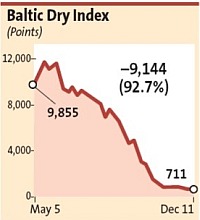
Food shortages showing up worldwide with more to come very soon. How do we know food will soon be in short supply? Look at the Baltic Dry Index.
________________________________
_______________________
What is the significance of this dramatic drop in the Baltic Dry Index [BDI]?
Changes in the Baltic Dry Index can give investors insight into global supply and demand trends. This change is often considered a leading indicator of future economic growth (if the index is rising) or contraction (index is falling) because the goods shipped are raw, pre-production material, which is typically an area with very low levels of speculation.
The index indirectly measures global demand for the commodities shipped aboard dry bulk carriers, such as building materials, coal, crude oil, metallic ores, and grains. These materials function as raw material inputs to the production of intermediate or finished goods, such as concrete, electricity, steel, and food, which makes the index an economic indicator of future manufacturing activity and, more generally, worldwide industrial output.
Investopedia
The BDI is considered a leading economic indicator of future economic activity. As we can see from the chart above, the BDI is indicating a bleak future for economic growth as global shipping of raw, pre-production material, including basic food stuffs, such as grains, sugar and rice, are curtailed.
As mentioned in a previous missive, Letters of Credit are not being honored or have become too expensive and may be a major reason for the dramatic drop in the BDI, along with falling global demand for basic commodities.
What does this mean? One important trend we can detect from this drop of 93% in shipping demand is that pre-production commodities needed to manufacture goods are not being made available to manufacturers, which will undoubtedly lead to future shortages in manufactured goods.
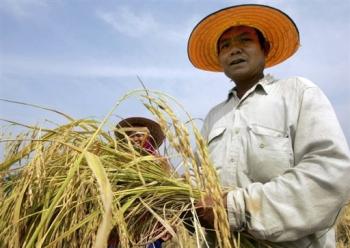
Perhaps more importantly, the precipitous fall in the BDI means that basic food stuffs - wheat, sugar, rice, etc - are not being shipped. In my locale I've already noticed there is no more wheat bread being made available at my location of the world’s third largest retail business. Also, Thai or any other imported rice is no longer available at the local Asian market that stocks imported food stuffs. The shop keepers there told me that Thailand is no longer shipping their rice. As an aside, Thai rice farmers have started guarding their rice fields as rice as become a much more valuable commodity. Thai farmers guard their fields
______________________________
__________________
What does this all mean for the average person like you and me? We will begin to see fewer and fewer imported goods on local store shelves. Unless the letters of credit system that businesses have used for centuries gets back on track and businesses can once again rely on the good faith and credit of the issuing banks, we will see continued shortages of a growing list of commodities, such as grains used in brewing beer, sugar in baking and other food production and rice used as a stable food source in many consumer's diets.
Once consumers notice shortages on their local shelves, the natural reaction will be to start buying what they can buy and store those foodstuffs at home rather than expect them to be available at a future date on store shelves. At that point, food shortages will appear overnight.
The other factor that will soon lead to a mad rush to buy commodities of all kinds, including food, is inflation. Once consumers realize the fiat currency they hold in their hand is losing purchasing power day-by-day, buying less tomorrow than it can today, they will buy today what they need tomorrow, leading to even more inflation as the velocity of money - how many times money changes hands - increases.
Bottom line is, Got stored food?
Read More...
Summary only...













 Posts